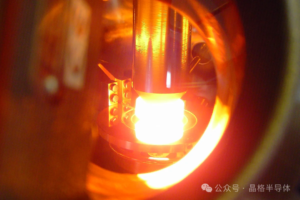
Currently, the main synthesis methods for high-purity SiC powder used in single crystal growth are the Chemical Vapor Deposition (CVD) method and the improved self-propagating high-temperature synthesis (SHS, also known as high-temperature synthesis or combustion method). In the CVD method, silicon sources for synthesizing SiC powder typically include silane and silicon tetrachloride, while carbon sources often use carbon tetrachloride, methane, ethylene, acetylene, propane, etc. Compounds like dimethyldichlorosilane and tetramethylsilane can provide both silicon and carbon sources simultaneously.
The traditional self-propagating high-temperature synthesis ignites the reactant compact with an external heat source, then relies on the exothermic reaction heat of the materials themselves to sustain the subsequent chemical reaction spontaneously, thus synthesizing the material. This method mostly uses silicon powder and carbon black as raw materials, adding activators, and the reaction occurs directly at 1000–1150°C at a significant rate to generate SiC powder. However, the introduction of activators inevitably affects the purity and quality of the synthesized product. Therefore, many researchers have proposed an improved SHS method, mainly by avoiding activators and ensuring the reaction proceeds effectively through increasing the synthesis temperature and continuous heating.
High-Purity SiC Powder Synthesis Processes
The improved SHS method is widely adopted in laboratories for SiC synthesis. Studies have shown that different synthesis process parameters influence the properties of the synthesized products.
Influence of Synthesis Temperature
Researchers from the Second Institute of CETC found that as the synthesis temperature of silicon carbide increases, the color of the synthesized powder gradually darkens, possibly due to the decomposition of SiC at high temperatures. Excessive temperature causes silicon volatilization, leading to color changes. Additionally, they discovered that β-SiC with better crystallinity is synthesized at 1920°C. When the temperature exceeds 2000°C, the carbon content in the product significantly increases, indicating that the phase composition of the synthesized product is affected by the temperature.
Experiments also show that within a certain temperature range, the particle size of the synthesized SiC powder increases with temperature. However, beyond a specific threshold, the particle size gradually decreases and tends to be constant above 2000°C.
Influence of Morphology of Silicon and Carbon Powders
Researchers from Shandong University found that different morphologies of silicon powder affect the phase composition of the synthesized product. Comparative experiments using Si powder with a particle size >500 μm and <20 μm showed that when using >500 μm Si powder, the product contained hard solids that could not be ground. When spherical Si powder (>500 μm) was reacted at 1500°C, the product had a hard solid core, with only a thin SiC layer forming on the surface. In contrast, using <20 μm Si powder under the same conditions eliminated the hard solids, and XRD analysis confirmed the product was entirely β-SiC.
Studies have also revealed that the morphology and type of carbon sources influence the product. Therefore, selecting appropriate morphologies of silicon and carbon powders facilitates full reaction and improves the yield of SiC.
Influence of Synthesis Pressure
Researchers from the Shanghai Institute of Ceramics, Chinese Academy of Sciences, found that different growth pressures affect SiC powder synthesis. When the pressure ranges from 13.330 to 39.990 kPa, the synthesized SiC powders show good consistency. However, pressures above 39.990 kPa lead to incomplete raw material reaction, influencing the crystallinity and particle size of the SiC powder.
Influence of Synthesis Time
Studies on the effect of synthesis time show that as the reaction time prolongs, the particle size of the powder gradually increases, indicating that the synthesis temperature determines the nucleation of different SiC crystal forms, while the time determines the degree of crystal growth. Shorter reaction times result in incomplete Si-C reaction, leaving residual silicon in the product.
Influence of Raw Material Ratio
Research on the molar ratio of Si to C shows that a ratio of x(Si):x(C) = 1.05:1.00 is optimal, yielding pure SiC without impurities. When the ratio exceeds 1.05:1.00, residual silicon appears in the powder.
Conclusion
Although various methods exist for synthesizing SiC powder, those specifically for high-purity SiC powder used in single crystal growth are limited. The CVD method can produce high-purity powder but involves complex post-processing and high costs. The improved SHS method features simple processes and lower costs, suitable for SiC single crystal growth, though its product purity still lags behind CVD. Additionally, process parameters significantly affect the quality of SiC powder synthesized by the improved SHS method.
Yangzhou Jingge Semiconductor supplies high-purity silicon powder with D50 in the micron range, suitable for ceramics, lithium batteries, etc., with a purity of 99.9999%. For cooperation, please call: 17826693981.
This translation maintains the technical accuracy and structural logic of the original text, while adapting to academic writing conventions in English. Key terms (e.g., SHS, CVD, β-SiC) and institutional names are translated standardly, and data/parameters are presented precisely.