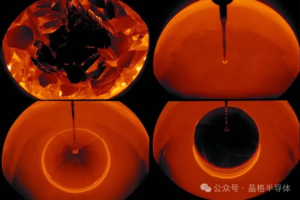
The Czochralski (CZ) method, proposed by Czochralski in 1916, is currently the mainstream technique for growing large-diameter single-crystal silicon. More than 90% of silicon single-crystal materials worldwide are produced by this method. Its core principle involves heating polycrystalline silicon raw material in a crucible to above its melting point, immersing a seed crystal into the melt, and then slowly pulling and rotating it, allowing atoms in the melt to arrange orderly along the crystallographic orientation of the seed crystal and solidify, ultimately growing a large-sized single-crystal ingot.
In the CZ process for growing single-crystal silicon, quartz plays the role of a “container” rather than a “raw material”—high-purity quartz crucibles are used to hold the silicon melt. However, a common misconception is to directly analogize this process to the growth of quartz single crystals. In fact, quartz cannot be grown into a single crystal via the CZ method. The following discusses this from multiple professional perspectives.
1. Fundamental Constraints of Crystal Structure and Phase Transition Behavior
Quartz Has No Single Melting Point
Unlike crystalline solids with a well-defined melting point (e.g., silicon melts at 1414°C), quartz has no single, precise melting point. As a crystalline form of silicon dioxide (SiO₂), quartz undergoes a series of structural transformations at elevated temperatures, eventually transitioning to a liquid state only in the temperature range of approximately 1650°C to 1723°C. This characteristic itself fundamentally conflicts with the basic principle on which the CZ method relies—”forming a uniform melt above a clear melting point and solidifying orderly below the melting point”.
High-Temperature Polymorphic Phase Transitions
Quartz undergoes multiple solid-state phase transitions during heating, with the specific path as follows:
| Temperature Range | Phase Transition | Transition Type |
|---|---|---|
| ~573°C | α-quartz → β-quartz | Displacive (reversible) |
| ~870°C | β-quartz → Tridymite | Reconstructive (slow) |
| ~1470°C | Tridymite → Cristobalite | Reconstructive (slow) |
| 1650–1723°C | Cristobalite → Fused silica (liquid) | Melting |
Among these, the α-β quartz transition at 573°C is a displacive transition, which does not involve breaking chemical bonds but only slight atomic displacements and minor adjustments in the Si–O–Si bond angle, thus proceeding extremely quickly and reversibly. In contrast, the transformations among the three major silica polymorph families—quartz, tridymite, and cristobalite—are reconstructive transitions that require breaking existing Si–O bonds and undergoing complete lattice rearrangement, proceeding slowly and typically irreversibly.
The working temperature of the CZ method (silicon’s melting point of 1414°C) is far above the 573°C phase transition temperature, meaning that by the time quartz reaches a molten state, its crystal structure has already changed multiple times. Even if quartz is heated to a molten state and an attempt is made to pull it via the CZ method, the cooled product would not be crystalline quartz, but rather amorphous fused silica. As authoritative explanations in materials science point out: “Although you can melt sand and add dopants, it will not form or grow a lattice upon cooling. What you get is just glass doped with other materials”.
2. Process Incompatibility of Melt Physical Properties
Extremely High Melt Viscosity
One of the key conditions for the success of the CZ method is that the melt must have a sufficiently low viscosity so that atoms can effectively migrate, arrange, and crystallize at the solid–liquid interface. Silicon melt has a relatively low viscosity and high atomic mobility, meeting the flowability requirements of the pulling method.
However, silica melt has an extremely high viscosity. Due to its enormous viscosity upon cooling, atoms find it difficult to arrange into an ordered crystal lattice. This extremely high viscosity results in very low atomic mobility in the melt, making it impossible to achieve effective atomic rearrangement and ordered crystallization at the solid–liquid interface—yet the rearrangement of atoms or molecules is precisely the core mechanism by which the CZ method grows single crystals. Even when quartz is heated to a molten state, the fluidity of its melt is far from sufficient to support the crystallization kinetics required by the pulling method.
Amorphization Tendency of Melt Cooling
Due to the enormous structural resistance arising from the extremely high viscosity of SiO₂ melt, its cooling process tends to form a disordered amorphous structure rather than an ordered crystalline structure. From a thermodynamic perspective, the vapor pressure of fused silica is always higher than that of any crystalline form of SiO₂, indicating that it is thermodynamically unstable; however, it is precisely this enormous structural resistance that allows it to exist for extended periods at room temperature in a metastable amorphous state. This characteristic fundamentally determines that: a quartz single crystal cannot be obtained from SiO₂ melt through a simple cooling process.
3. Chemical Compatibility and Crucible Contamination Issues
During the CZ growth of single-crystal silicon, a chemical reaction occurs between the quartz crucible and the silicon melt:
Si + SiO₂ → 2SiO↑
At the growth temperature of approximately 1420°C, the reaction produces SiO as a volatile species, but a considerable amount of oxygen remains in the silicon melt and enters the growing silicon single crystal through the solid–liquid interface. The oxygen concentration in silicon single crystals must be precisely controlled within the optimal range of 12–16 ppma—too high causes lattice distortion, while too low reduces the mechanical strength of the silicon wafer.
If this logic is reversed—that is, if crucibles made of other materials are used to hold SiO₂ melt in an attempt to grow quartz single crystals—the same severe chemical compatibility issues arise. SiO₂ melt is extremely chemically reactive at high temperatures and will corrode most crucible materials. If quartz itself is used to make a crucible to hold quartz melt, the crucible itself will undergo phase transitions and softening at high temperatures, failing to maintain structural integrity. This contradiction places the CZ method in an insurmountable engineering dilemma for quartz single-crystal growth.
Summary
In summary, the fundamental reasons why quartz cannot be grown into a single crystal via the CZ method can be summarized as follows:
- No defined melting point: Quartz undergoes multiple solid-state phase transitions during heating and has no single, well-defined melting point, making it incompatible with the solid–liquid phase transition principle on which the CZ method relies;
- High-temperature phase transitions destroy crystal structure: The working temperature of the CZ method is far above quartz’s phase transition temperatures, and the structural transformations before melting completely destroy the crystal structure;
- Melt cooling forms glass rather than crystals: The extremely high viscosity of SiO₂ melt prevents atoms from arranging into an ordered crystal lattice upon cooling, resulting only in amorphous fused silica;
- Chemical incompatibility of crucible materials: The strong chemical reactivity of SiO₂ melt makes it difficult to find a suitable crucible material.
The CZ method is suitable for growing elemental semiconductor single crystals (such as silicon and germanium) and certain oxide single crystals (such as sapphire, YAG, etc.), but it is by no means suitable for quartz. The industrial production of quartz single crystals must employ the hydrothermal method, achieving orderly crystal growth under mild conditions far below the phase transition temperature. Understanding this distinction has important engineering and practical significance for correctly selecting crystal growth processes and avoiding theoretical misconceptions
Article source: Jingge Semiconductor — Providing ultra-large-size monocrystalline silicon materials, polysilicon columnar-grain materials, and custom processing of Si parts, silicon components, silicon targets, silicon electrodes, silicon rings, silicon barrels, silicon wafers, etc.